History of the Cloud 2
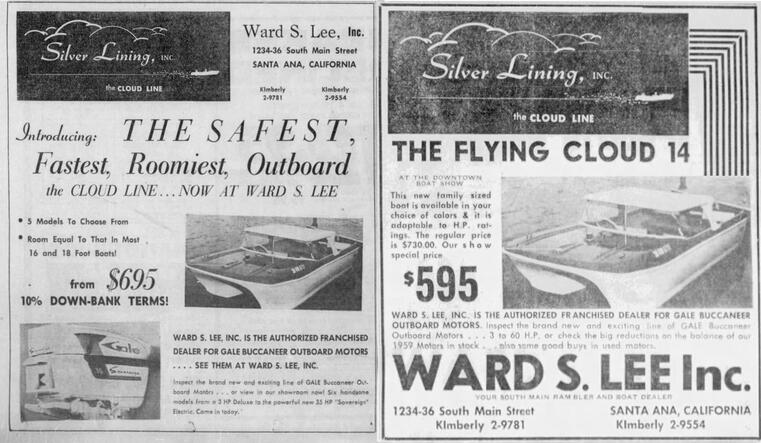
The history of the Canton Cloud starts on the west coast in the mid-late 1950s when the fiberglass boat industry was beginning to get into full swing and catamarans were being developed as a stable and safe alternative to monohull boats. Silverlining Incorporated was a fiberglass boat company located in Costa Mesa, California (660 West 17th Street) that manufactured 12, 14, 16, 18, and 20 foot catamaran and sled hulls. Robert Slining, an engineer, patented a catamaran hull design in the mid-fifties that was used to create the Cloud I catamaran boat around 1957. This boat was sold around 1957-1958. An updated design, the Cloud 2, was developed in 1959 and started production around July 1959 with five different models (at least three are known – straight hull, finned, and hardtop). This boat was marketed in Southern California as “the Flying Cloud 14” and “The Safest, Fastest, Roomiest, Outboard – the Cloud Line,” a part of Silver Lining, Inc’s “the Cloud Line” per newspaper advertisements in 1959. Newspapers list this boat at a regular price of $695 to $730 at the time (with some dealers offering ‘sales’ prices of $595). These boats were equipped with Gale, Mercury, and Johnson motors depending on the dealership (Ward S Lee (Gale), Willis E Hunt (Mercury), etc.). The boat was shown in boat shows in Southern California during 1959-1960.
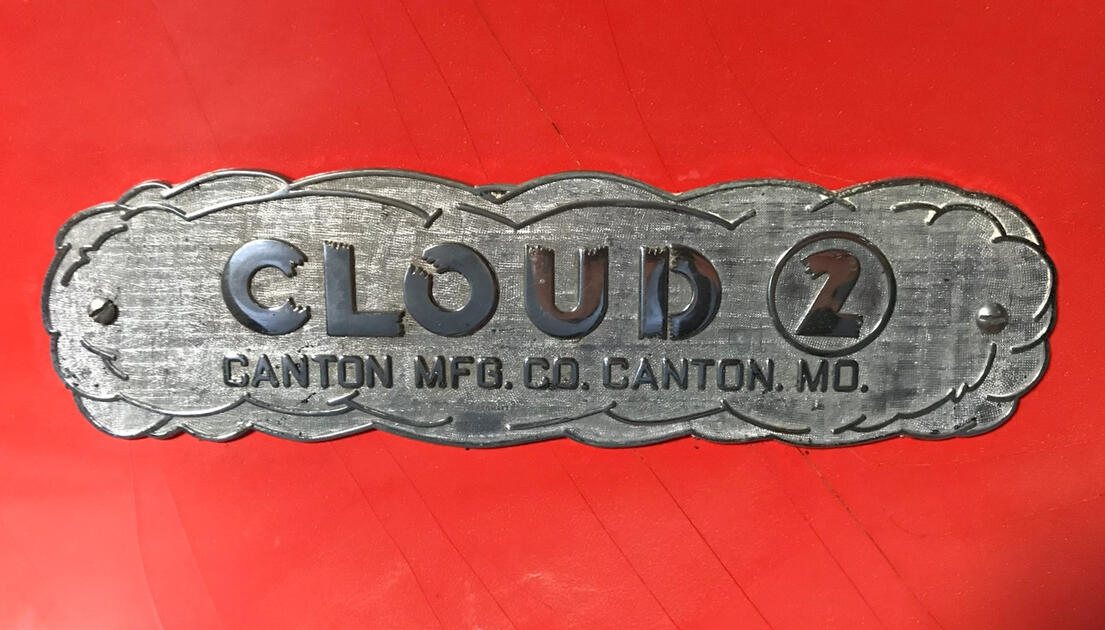
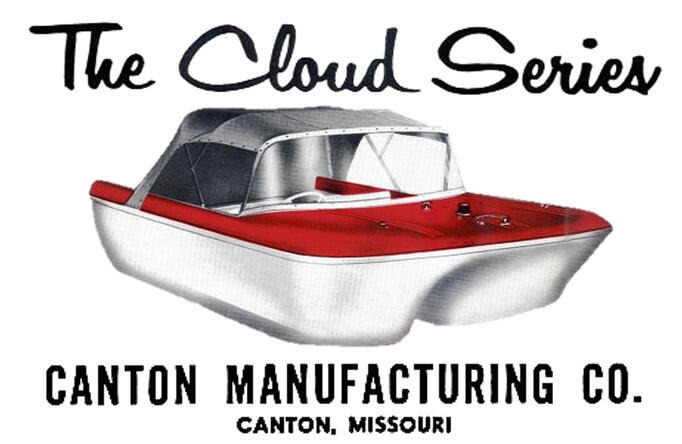
During the 1950s, the Canton Chamber of Commerce was actively recruiting businesses to invest in the community and was connected with Silverlining Incorporated in Costa Mesa. It was agreed that Canton, situated on the Mississippi River, would serve as a Midwestern/Eastern production facility for the new Cloud 2 catamaran boat, serving a projected 37 states. On May 4, 1959, the Canton Manufacturing Company was formed by 21 stockholders in Canton to produce catamaran fiberglass pleasure boats and trailers in Canton with an expected start date of July 1st. On May 16, 1959, the Canton Manufacturing Company held an election of directors to their board: Orville Dickey (Chairman), J. W. Carty (VP), William Reger (VP), Jack Hartmann (Secretary/Treasurer), Earle Zenge, J. Andy Zenge Jr., and W. H. Ayers.
May through July 1959, hiring advertisements were placed in the papers for workers in the various departments of the Company (carpentry, fiberglass, assembly, upholstery, metal shop, warehouse room, and painting). The manufacturing facility was located in the 24,885 square foot Canton Chamber of Commerce building at 302-306 Lewis Street (Northwest corner of 3rd and Lewis) and was expected to employ 12 to 15 people with a capacity of six boats per day. William Reger was hired as the plant manager and Bob Phillips, the chief engineer and molder of the California plant, was expected to be in Canton for around a year to supervise the startup of production. The boats were advertised as selling for between $695 and $995. The boat molds, shipped from Costa Mesa, California, arrived in Canton late June 1959.
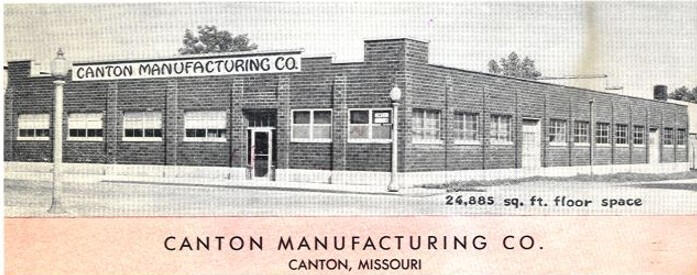
Production started in late July 1959, with only around eight boats being completed per week by September with 25 actual employees at the facility. Employed with the Canton Manufacturing Company in September 1959 were Orville Dickey (President), Jim Carty (VP/Plant Manager), Bill Reger (VP/Sales Manager), Mrs. George Martin (Secretary), and Bob Phillips (of California as head of the molding department). An open house was held on September 20th, 1959, with 300 people in attendance receiving tours of the facility and being shown completed boat models. Production continued throughout the fall of 1959, with announcements that the production rate was going to be increased due to dealer inquiries and orders throughout the Midwest. Production had to stop in early December 1959 due to cold weather and insufficient heating in the fiberglass molding room which prevented proper curing of the fiberglass, however, this was expected to be corrected in a short time.
Production and sales continued into the first half of 1960 per a June 1960 newspaper article. In addition, there are many newspaper advertisements in 1960 listing the new Canton Cloud 2 as being available at dealers in Quincy IL, Decatur IL, Des Moines IA, Kansas City MO, Colorado Spring CO, Louisville KY, and Tulsa OK. For the March 1960 Mississippi Valley Sports and Boat Show held at the Quincy, Illinois armory, the Canton Manufacturing Company donated a $1,300 Canton Cloud 2 catamaran as first prize for the competition.
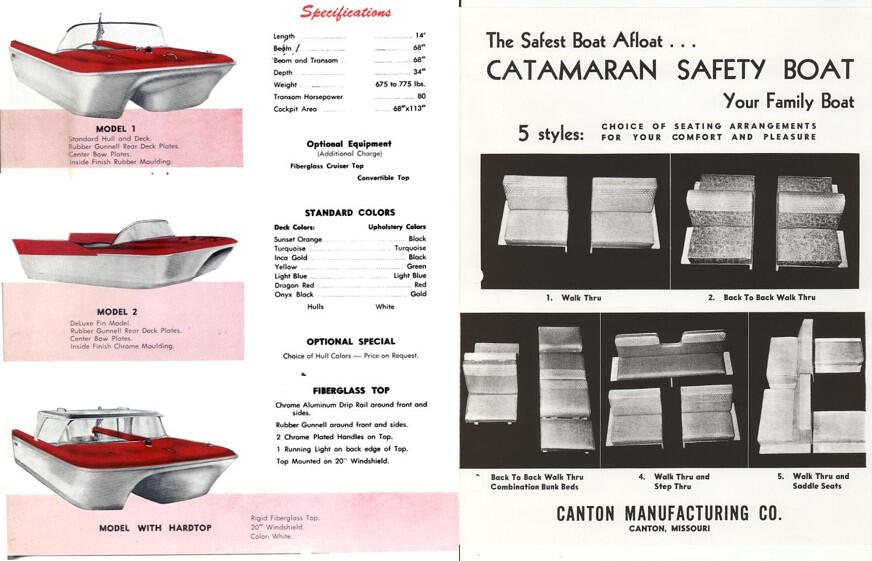
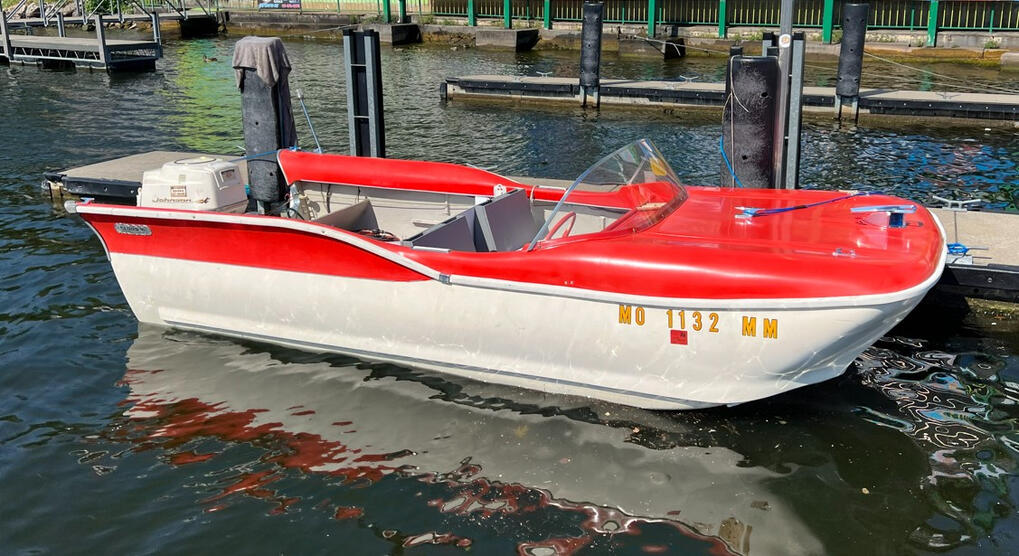
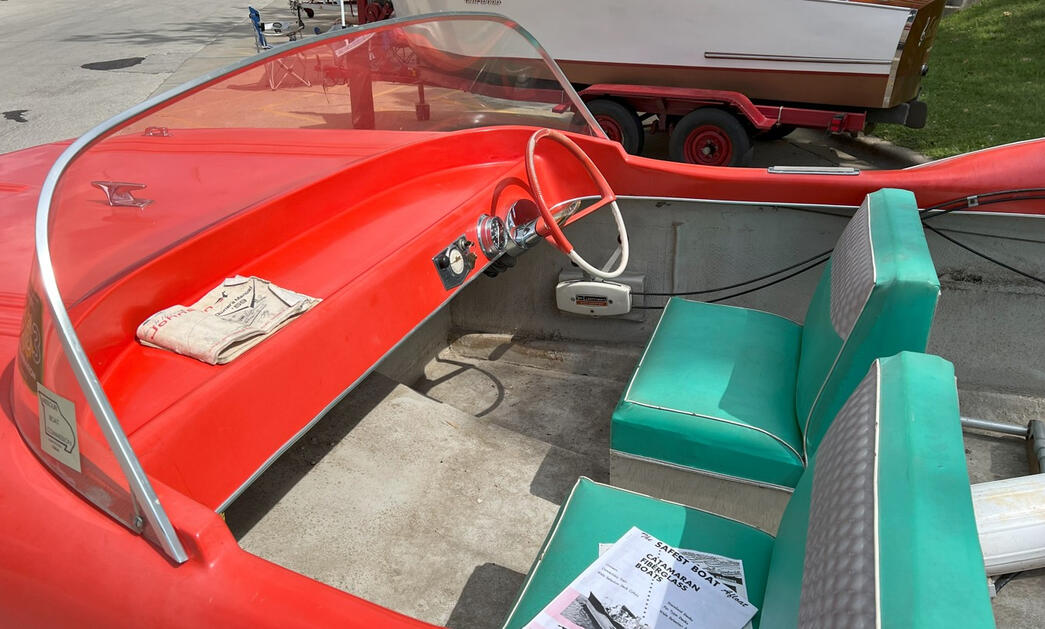
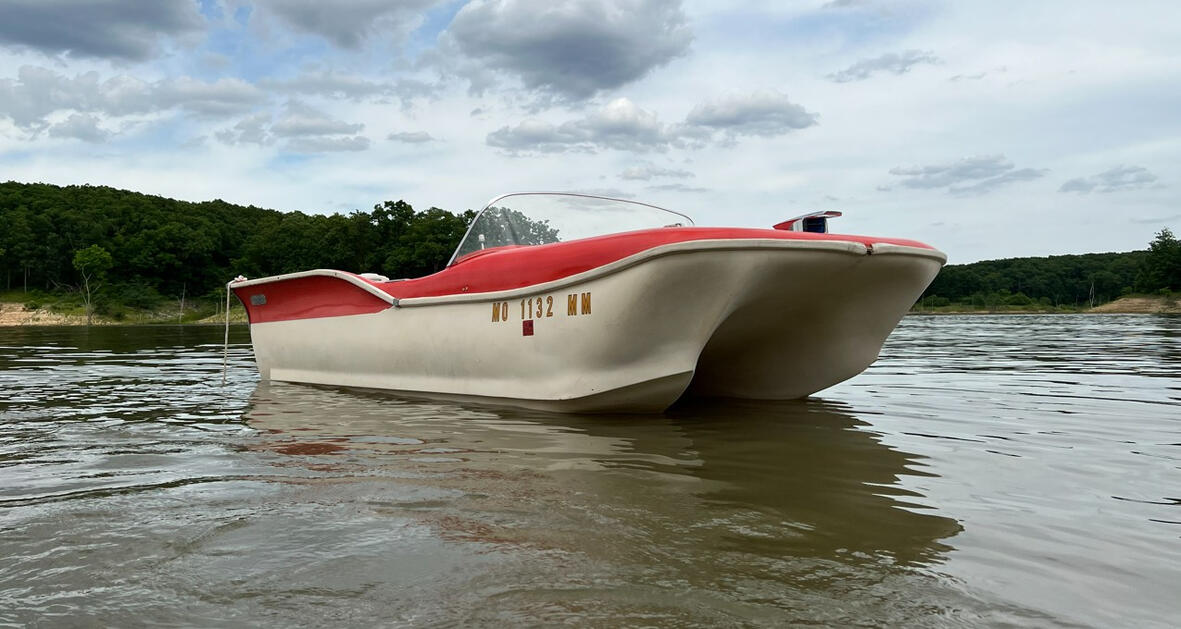
The cloud was offered in three different model types: “Standard Hull and Deck” (Model 1); “Deluxe Fin Model” (Model 2); and “Hardtop” (Model 3). An optional soft plastic “convertible top” was available. Two tone color schemes were standard; all featuring a white lower hull (special hull colors were available upon request) and a top deck available in seven colors: Sunset Orange, Turquoise, Inca Gold, Yellow, Light Blue, Dragon Red, and Onyx Black. Five different interior seating layouts could be chosen with vinyl upholstery in six colors: Black, Turquoise, Green, Light Blue, Red, and Gold. Green enameled trailers were produced and sold with a 1,000 pound capacity and trailering lights. The boat hull consisted of an outer shell with an inner bottom floor, with the space between divided into four separate compartments that stretched from the bow to the stern and were filled with “poured” foam for safety. The hull also featured a stress plate tying the two catamarans together.
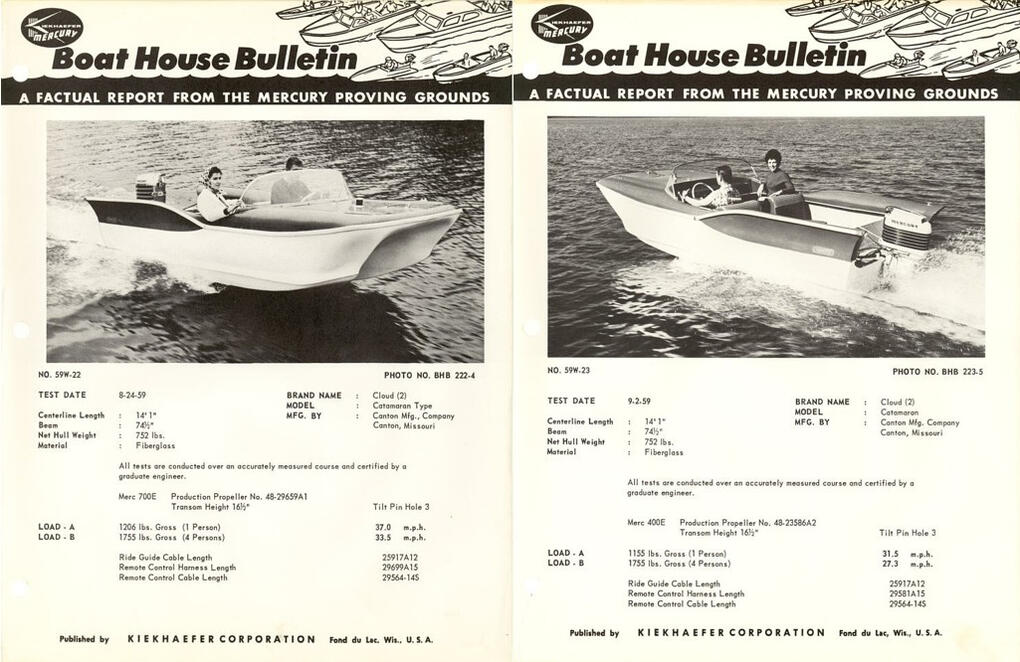
A piece in the Mercury Boathouse Bulletin magazine from 1959 features testing data from the Mercury Outboard proving grounds for the Cloud 2. The testing date was listed as August 24, 1959, and tested was a fin model (Model 2) Cloud 2 equipped with a Mercury 700E outboard. Top speed with a driver was 37 mph and with four total occupants, 33.5 mph was the top speed. The article also features measurements of the boat: centerline length of 14 feet, 1 inch; beam of 74.5 inches; net hull weight of 752 pounds. Another test was conducted on September 2, 1959, with a Mercury 400E outboard with slightly slower times of 31.5 mph and 27.3 mph with one and four occupants, respectively.
Silverlining Incorporated in Costa Mesa went bankrupt in 1961 and a bankruptcy auction was held at their premises on July 7th, 1961 where their assets (boat molds, boat trailers, boat hardware, etc.) were put up for sale. No other mentions of this company were found in newspaper archives after this time online. As this was the partner corporation for the Canton Manufacturing Company, it can be assumed that the declining business in the time leading up to the bankruptcy had negative consequences for its operations. Advertisements in newspapers for the Canton Cloud 2 continued to appear throughout 1960 and into 1961-1962, however, when model years were listed, there were none newer than 1960. As such, it would be a logical assumption that production of these fiberglass boats ended in 1960 due to declining sales. The fiberglass industry of the late 1950s – 1960s was constantly changing and new designs needed to be produced each year to keep up with consumer tastes. The catamaran was a very popular boat in the late 1950s as it was the choice of many boat racers (and continues to be today). However, once the novelty of the design wore off for recreational boaters, it appears production of these boats subsided. There are no total production numbers we have found for the Canton Manufacturing Company’s Cloud 2, however, an example produced in August 1959 that survives today is tagged as boat number 82. It is likely between one- and two-hundred were produced, however, we have only found three surviving hulls of the Canton boat; with number 82 being the only complete, water-worthy example.
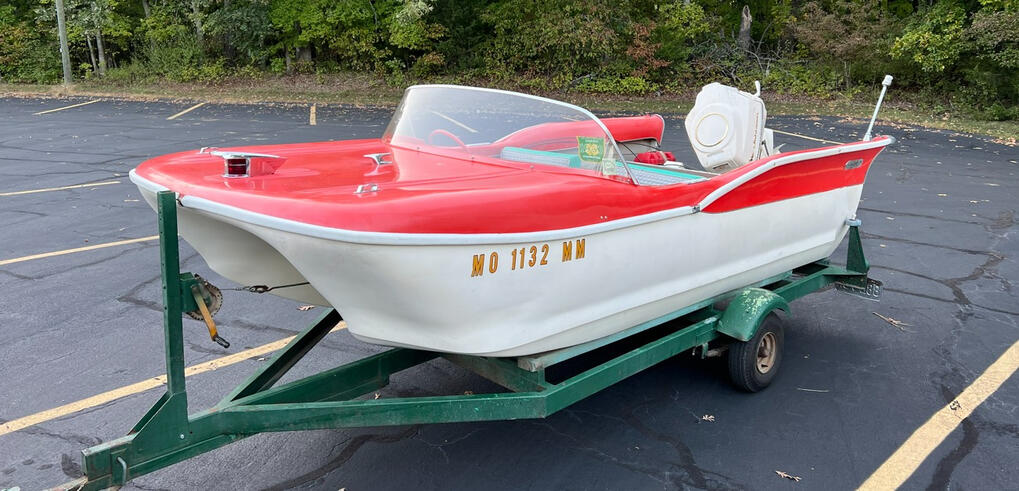
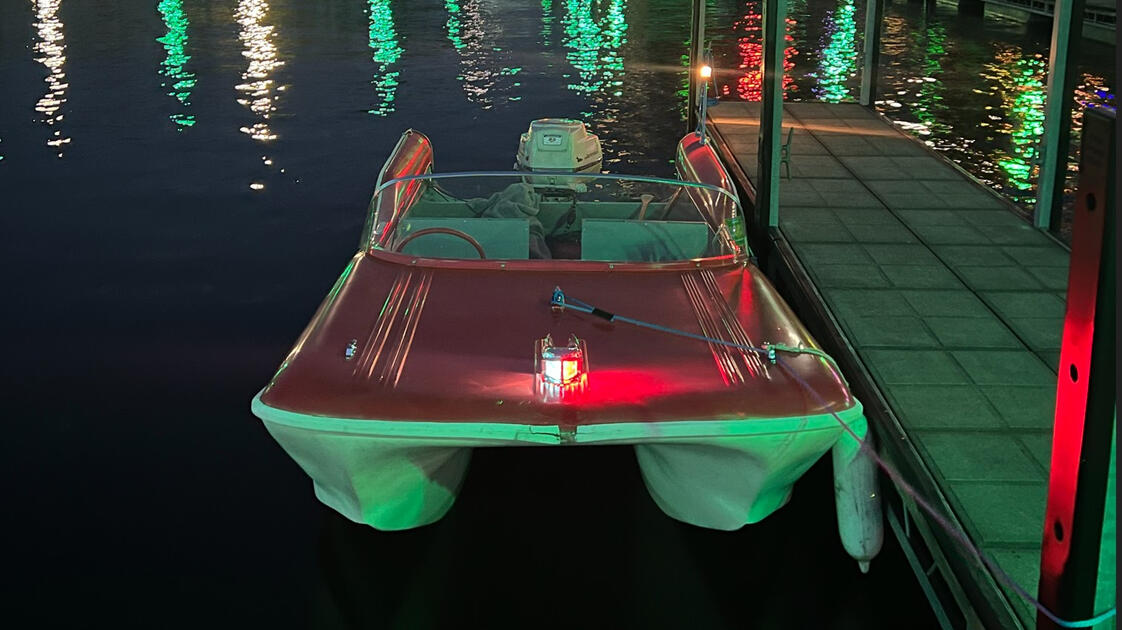
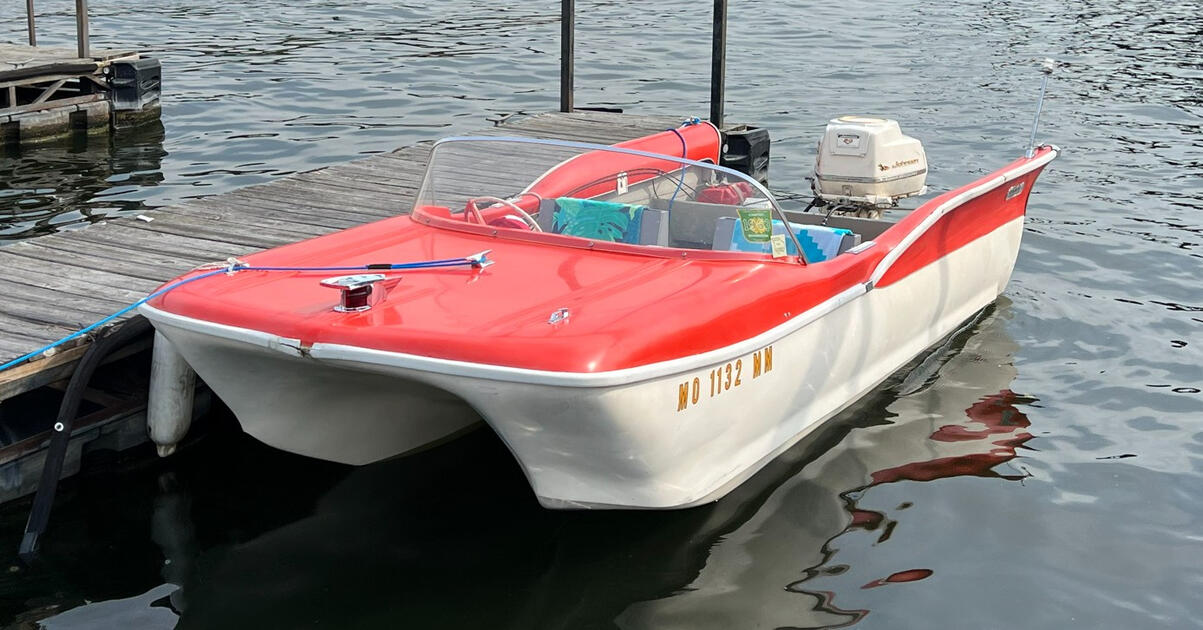
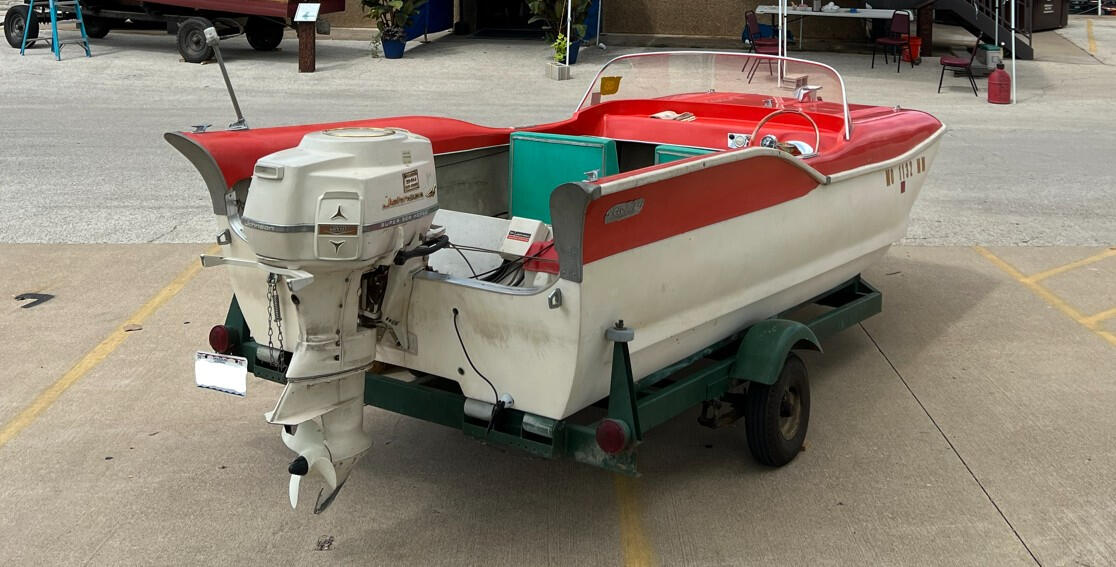
Featured Boat: Number 82 was purchased in Kirksville, Missouri, in 1959 by the President of the Bank of Clarence, Missouri, who owned the boat for a few years until he sold it in the early 1960s. Another Clarence family purchased the boat and used it on various Northern Missouri lakes and rivers as a family boat until they parked it in their garage in 1974. The boat then sat until sold to us at an estate sale in 2020. It was a complete Deluxe Fin Model (Model 2) boat in Sunset Orange with the original green vinyl captains’ chairs. The boat also had its original 1959 Johnson Super Sea Horse (“fat fifty” – 50 horsepower V4) motor. As the boat was garage kept, the boat was structurally, cosmetically, and mechanically well-preserved. We have completed some basic cosmetic and mechanic work to the boat to enable us to take it out on the water and to boat shows. We replaced some parts on the motor to get it running again, replaced the rub rail and gunwale steps with new rubber, replaced the silver stripe on the fins, replaced the broken battery box (reusing the original lid), replaced the steering cable, and polished the fiberglass. We also made replica green vinyl seats for it as we did not want to crack or tear the original vinyl seats when using the boat (we take the originals to boat shows and set them by the boat). Otherwise the boat is a great, original example of this chapter in Canton, Missouri, history as well as the early days of fiberglass boating.